





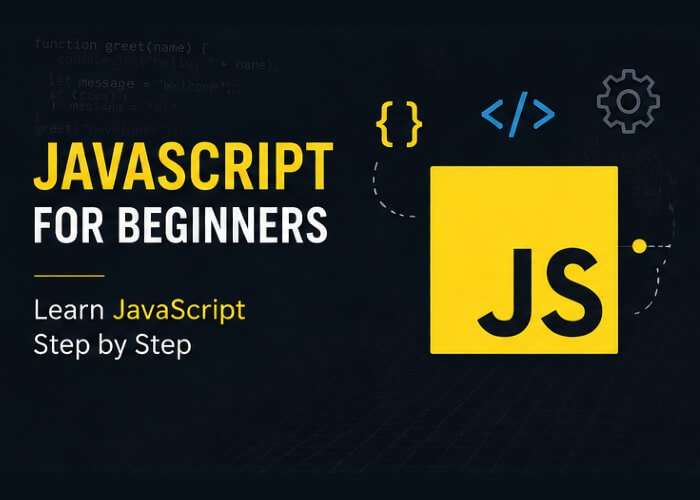
When you visit a modern website, you probably interact with menus, buttons, forms, sliders, popups, animations, and many other dynamic elements. A large part of this interactivity is made possible by JavaScript.
JavaScript is a programming language widely used for creating interactive and dynamic websites. It works alongside HTML and CSS to turn a static web page into an application that can respond to user actions.
If you are starting your web development journey, understanding JavaScript is an important step.
What Is JavaScript?
JavaScript is a programming language designed to add behavior and interaction to web pages.
HTML is generally responsible for the structure of a page, while CSS controls its appearance. JavaScript adds logic and behavior.
For example:
- HTML can create a button.
- CSS can make the button look attractive.
- JavaScript can perform an action when the user clicks it.
A simple JavaScript example looks like this:
let name = "Developer";

console.log("Hello, " + name);
Here, JavaScript stores a value in a variable and then displays a message in the browser console.
Why Is JavaScript Important?
JavaScript has become an important part of modern web development because websites are no longer limited to displaying static information.
Developers use JavaScript to build:
- Interactive websites
- Web applications
- Online forms
- Dashboards
- E-commerce interfaces
- Browser-based games
- Real-time applications
- Mobile applications
- Server-side applications
JavaScript can also be used outside the browser through environments such as Node.js.
JavaScript and HTML
JavaScript can interact with HTML elements on a web page.
For example:
<button id="welcomeButton">Click Me</button>

<script>
document.getElementById("welcomeButton").addEventListener("click", function() {
    alert("Welcome to Developers Ground!");
});
</script>
When the user clicks the button, JavaScript displays a message.
This simple example demonstrates an important concept: JavaScript can listen for user actions and respond to them.
JavaScript and CSS
JavaScript can also modify the appearance of HTML elements.
For example:
const heading = document.querySelector("h1");

heading.style.fontSize = "40px";
The code finds an <h1> element and changes its font size.
This capability is commonly used to create interactive interfaces.
What Can JavaScript Do?
JavaScript provides many capabilities for developers.
1. Change HTML Content
JavaScript can change the content displayed on a page.
document.getElementById("message").textContent = "Hello JavaScript!";2. Handle User Events
JavaScript can respond to events such as:
- Clicks
- Mouse movements
- Keyboard input
- Form submissions
- Page loading
3. Validate Forms
Before sending information to a server, JavaScript can check whether users have entered valid information.
For example, a registration form can check whether an email address has been entered correctly.
4. Communicate With APIs
Modern applications frequently communicate with backend APIs.
JavaScript can request information from an API and display the result without requiring the entire page to reload.
5. Build Complete Applications
With technologies such as React, Angular, and Vue, developers can use JavaScript to build sophisticated frontend applications.
Where Does JavaScript Run?
JavaScript is most commonly associated with web browsers.
Popular browsers such as Chrome, Firefox, Edge, and Safari contain JavaScript engines capable of executing JavaScript code.
JavaScript can also run on servers using environments such as Node.js.
This means developers can use JavaScript for both frontend and backend development.
Is JavaScript Difficult to Learn?
JavaScript can seem confusing at first because the language contains many concepts.
However, beginners can learn it step by step.
A good learning sequence is:
- Variables
- Data types
- Operators
- Conditional statements
- Loops
- Functions
- Arrays
- Objects
- DOM manipulation
- Events
- Asynchronous JavaScript
- APIs
- Modern JavaScript features
Once these fundamentals are comfortable, learning frameworks and libraries becomes much easier.
JavaScript vs Java
Despite their similar names, JavaScript and Java are different programming languages.
JavaScript is widely used for web development and interactive applications, while Java is commonly used for backend systems, enterprise applications, Android-related development historically, and many other software systems.
The two languages have different syntax, ecosystems, and use cases.
Final Thoughts
JavaScript is an excellent language for anyone interested in modern web development. It allows developers to create websites that can react to users, communicate with APIs, update content dynamically, and provide application-like experiences.
If you are a beginner, don’t try to learn everything at once. Start with the fundamentals and build small projects as you learn.
Learning by building is one of the most effective ways to become comfortable with JavaScript.


